
Start date: 2021
Award: £50,000
Status: Complete (2021-2023)
What problem did this research address?
In the past, doctors have tended to look at how we can cure the cancer, but as more people are surviving the disease, there is an urgent need to look into how to improve patients’ lives after a cure. The results of having treatment for bowel cancer can leave 80% of patients with poor control of their bowels for at least one year after surgery, and for 25% of patients, this can be a long-term problem (known as LARS).*
How did this study work?
The aim of this study was to find out how useful existing treatments for LARS are and to potentially create a treatment pathway that doctors can use to improve bowel function in those who have had surgery. The POLARiS study included all patients from four UK hospitals having surgery for bowel cancer on the left side that involves a join to the rectum (lower part of the bowel). The money provided by Bowel Research UK funded the first part of the study, which has now been completed.
The team have since gone on to receive £3.7 million in additional funding from the National Institute for Health and Care Research (NIHR) and Australia’s National Health and Medical Research Council, which means the trial can be expanded to 20 hospitals across the UK and 10 in Australia. Around 1,500 patients are projected to take part.
What could this study achieve?
By doing these studies, the team will increase the awareness of the problem of poor bowel function after bowel surgery and determine the best treatments to alleviate symptoms.
The research team
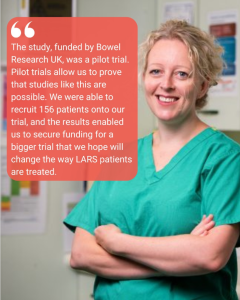
This research team was led by Mrs Julie Cornish, a Consultant Colorectal Surgeon working at the University Hospital of Wales. Read more about Mrs Cornish’s work.
* Statistic from https://www.bbuk.org.uk/low-anterior-resection-syndrome-case-study/ Accessed 08.10.25
Final Report Summary
Low Anterior Resection Syndrome (LARS) describes a set of bowel problems that people who have had bowel surgery for cancer sometimes experience. LARS is common and is seen in around 40% of patients who have had bowel surgery. It can include trouble with incontinence (not being able to control bowels), unpredictability of bowels (not following a regular routine), clustering (needing to go to the toilet a lot in a short space of time) and urgency (needing to go to the toilet straight away and not being able to hold on). People with LARS can have one or more of the symptoms, and they can happen all the time or not very often. Even though LARS is quite common, it is not diagnosed very often, and there is no agreement on what the best way to treat LARS is.
The aim of the POLARiS feasibility study was to see if a type of clinical trial called ‘TWiCS’ can be used to test the treatments for LARS. The benefit of using this kind of trial is that we can use it to both find people with the condition and invite them to have a treatment.
We invited patients who had had bowel surgery for cancer to take part in the project and asked them questions about their bowel symptoms. People who had lots of bowel problems were then invited to have treatment for symptoms. Each patient was randomly given either:
- SNM (‘Sacral NeuroModulation’)- a small electronic device that helps bowel control.
- TAI (‘Trans-Anal Irrigation’)- a system that washes out the back passage to make sure its empty
- OCM (‘Optimised Conservative Management’)- a combination of diet, exercise and medication that depends on the patient’s symptoms.
All patients were followed over 12 months to see if they stuck to their treatment.
We found that 78% of the patients we tested had some form of bowel problem. 65% of those had the worst form of bowel problems. 40% of the people with the worst form of bowel problems took part in the treatment trial. 45% kept to their treatment plan.
80% of the participants who received treatment showed a reduction in their bowel dysfunction symptoms. Of those, 35% no longer reported the most severe form of LARS. This suggests that the treatment options under investigation may be effective in alleviating bowel dysfunction after cancer surgery and that a full-scale trial is needed to provide decisive evidence.
As a result of this research, we have concluded that the TWiCs trial design is not only feasible, but also an effective way of identifying and recruiting patients with LARS.
We intend to do a bigger trial using this type of trial to see which is the best treatment for LARS. We have been successful in obtaining over £2m of funding to conduct a full-scale POLARiS trial. The information we collected during the study is being used to make sure that the bigger trial runs well and gives the best possible results.
Impact of Bowel Research UK funding
Thanks to Bowel Research UK we have been successful in securing significant funding from the National Institute for Health and Social Care Research to assess the treatment options for patients living with Low Anterior Resection Syndrome.
Bowel Research UK funding allowed us to conduct a preliminary clinical research study to test the feasibility of a novel trial design. We have refined the clinical study protocol and procedures and are confident that we can successfully deliver a full-scale clinical trial using this design.